How it works
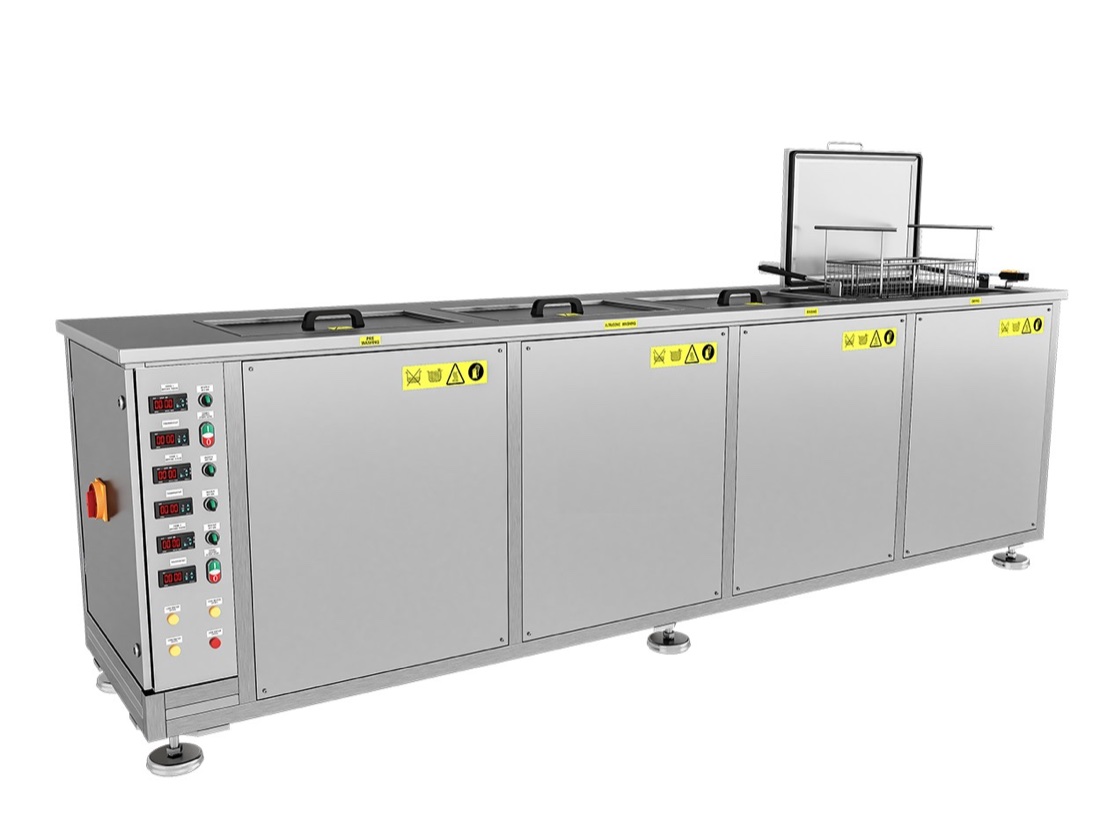
In ultrasonic cleaning, electrical oscillations are converted by transducers into sound waves and transmitted into a liquid cleaning bath. The rapid alternation between positive and negative pressure generates microscopic cavitation bubbles in the liquid, which implode at the part surface. These implosions mechanically detach contamination, including in places brushes and spray jets cannot reach: bores, threads, undercuts and capillary gaps.
TeSe covers both ultrasonic and megasonic cleaning. Megasonic cleaning operates at higher frequencies and therefore acts more finely and more gently: relevant for sensitive surfaces and fine cleaning. The cleaning effect is matched to the part and the contamination via frequency, cleaning medium, temperature and exposure time. Ultrasonic tanks are available in various sizes and frequencies.
Advantages
- Acts throughout the entire bath, including in bores, threads and undercuts
- Suitable for batches containing many small and very small parts
- Gentle on the base material when frequency and medium are properly matched
- Can be matched to the cleaning chemistry from the TeSe range (aqueous cleaners, solvents)
- Scalable: from a single ultrasonic tank to multi-stage batch systems
- An established process for pre-, intermediate and fine cleaning
Typical applications
- Removal of oils, greases, emulsions, polishing pastes and particles after machining
- Cleaning of small and very small parts in batch operation
- Parts with complex geometries where spray or immersion processes alone are not sufficient
- Fields of application include medical technology, watchmaking and plastics processing
Suitable ultrasonic tanks, washing baskets and batch systems can be found under Cleaning systems.
Test the process at TeSe
Whether ultrasonic cleaning is the right process for your part and its contamination is best established in a trial: 1–2 hours of testing free of charge. In-depth feasibility studies: CHF 1’200 per day, 50% credited towards a machine purchase.