Working principle
Plasma is an energetically excited gas state. When a process gas is excited electrically, reactive species form and react with the part surface, without any use of chemicals. As a key technology for fine cleaning, surface activation and plasma coating, the process covers three tasks that often come immediately before bonding, painting or printing: it removes the finest organic contamination, raises the surface energy for better wettability and can deposit functional layers.
TeSe works with two variants. Atmospheric plasma (Openair) operates at ambient pressure: the nozzles can be robot-guided and integrated cost-effectively directly into the production line. Vacuum plasma treats parts in batches in a process chamber and also reaches complex geometries. The technology partner for both variants is Ferrarini & Benelli.
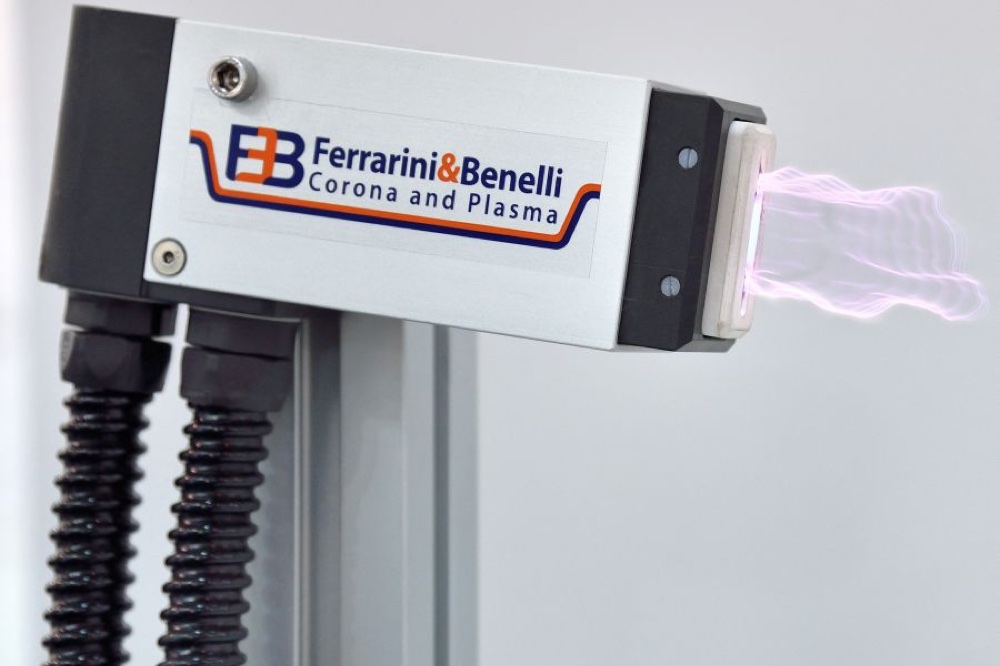
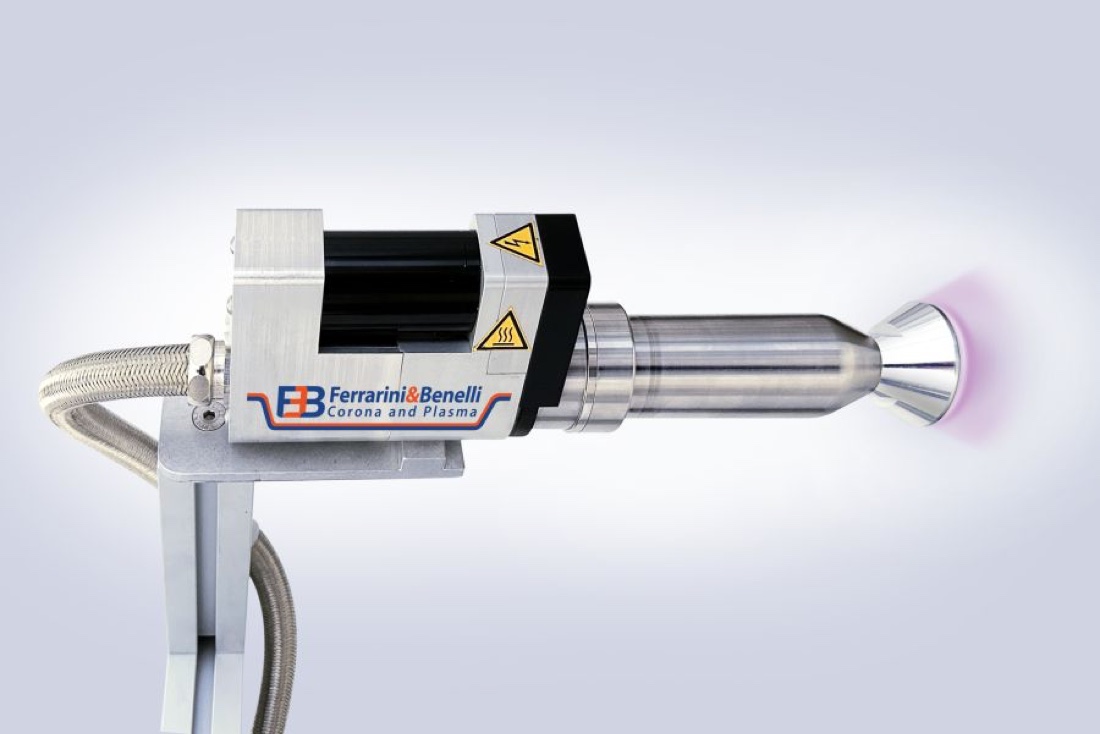
Corona pre-treatment for large, flat substrates
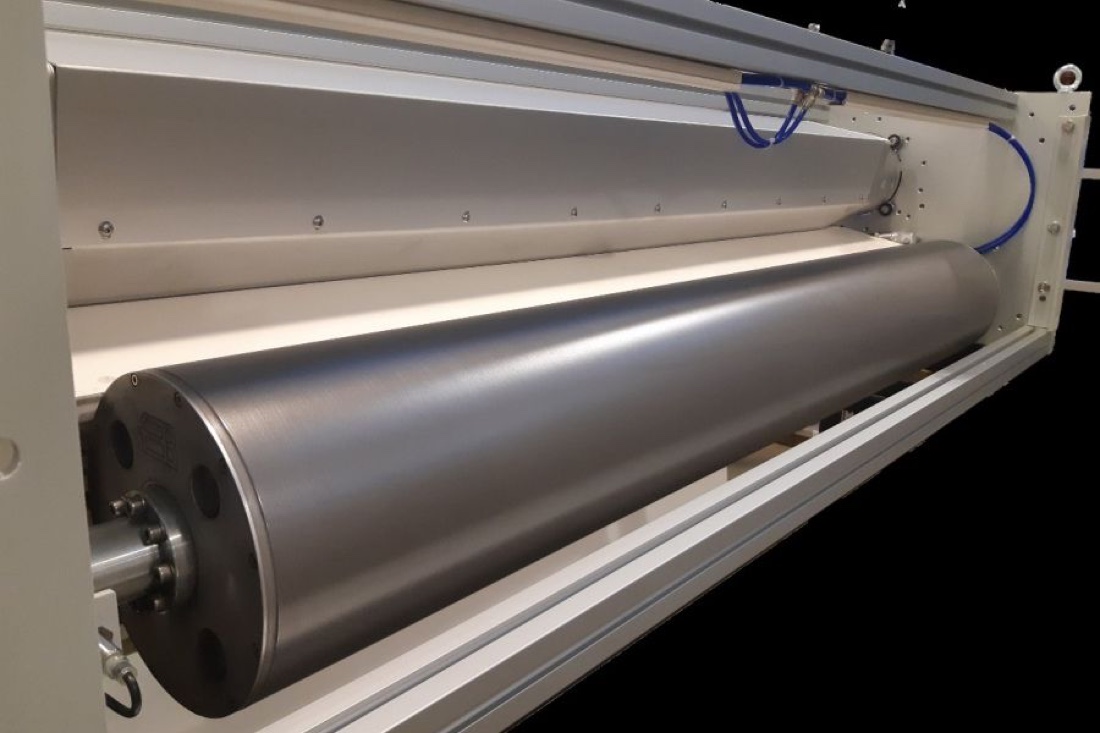
For large, flat substrates: especially plastic films and web material. Corona pre-treatment is often the most economical solution. In a corona discharge, the surface is activated with a defined power over a defined time: the surface energy (measured in dynes/cm) rises so that printing inks, adhesives and coatings adhere reliably. This is particularly important for polyethylene and polypropylene films, whose surface tension is naturally low. Technology partner Ferrarini & Benelli specialises in corona systems (“Corona and Plasma”), from laboratory units to wide-web installations.
Application in battery cell manufacturing
In battery cell manufacturing we pre-treat aluminium cell housings before they are placed onto the bonding plate with a defined contact pressure. Atmospheric pressure plasma activates the aluminium surface immediately before joining: the adhesive wets better and the bond inside the cell holds more reliably. This shows up in the pull-off force: precisely the figure that matters for this bond.
What makes the process suitable here are its properties: it works dry and without chemicals, it requires no downstream drying step, and the nozzles can be integrated into the cycle of a line under robot guidance, so the pre-treatment sits directly ahead of the bonding station instead of interrupting production for a separate cleaning step. At this customer the system is integrated into an automated production line by Aerne Engineering AG in Arbon.
What the pre-treatment achieves in testing
We measured the size of the effect on aluminium specimens, in a lap shear test, that is with the force acting parallel to the bond line:
| Pre-treatment | Strength | vs. untreated |
|---|---|---|
| none | 4.8 N/mm² | : |
| plasma only | 5.6 N/mm² | +16 % |
| laser only | 7.6 N/mm² | +58 % |
| laser and plasma | 8.1 N/mm² | +68 % |
What stands out: on aluminium the laser is the stronger lever. It creates the microstructure the adhesive grips into; the plasma activates the surface chemically and adds another ten percentage points. Only together do they produce the strongest bond. Our video shows the full test: Atmospheric plasma combined with laser on aluminium parts.
These figures come from the lap shear test and cannot be transferred to pull-off force: those are different load cases. Which figure matters for your part is something we establish in the cleaning trial.
Advantages
- Fine cleaning, surface activation and plasma coating with a single technology
- Without any use of chemicals: a dry process with no downstream drying steps
- Atmospheric variant (Openair): robot-guided and suitable for inline integration into the production line
- Vacuum variant: batch treatment, also suitable for complex part geometries
- Corona variant: economical activation of large, flat substrates such as films and web material
- Improved wettability and adhesion in preparation for bonding, painting and printing
- Technology-neutral selection of the appropriate variant by TeSe
Typical applications
- Pre-treatment of plastic and metal surfaces before bonding, painting or printing
- Inline pre-treatment in automated production lines, for example in plastics processing, automotive and battery cell manufacturing
- Fine cleaning and activation of sensitive parts, for instance in medical technology
- Activation of aluminium cell housings before bonding in battery cell manufacturing
- Batch treatment of complex parts using vacuum plasma
- Corona activation of plastic films and web material before printing, laminating or coating
Test the process at TeSe
To find out whether plasma or corona pre-treatment suits your part and your contamination, we run trials in Nürensdorf: 1–2 hours of tests free of charge. In-depth feasibility studies: CHF 1’200 per day, 50% credited towards a machine purchase.
Documents & videos for this process
Datasheets & brochures
- Ferrarini & Benelli · BrochureEN
Videos
Technology Partner · Ferrarini & Benelli