How it works
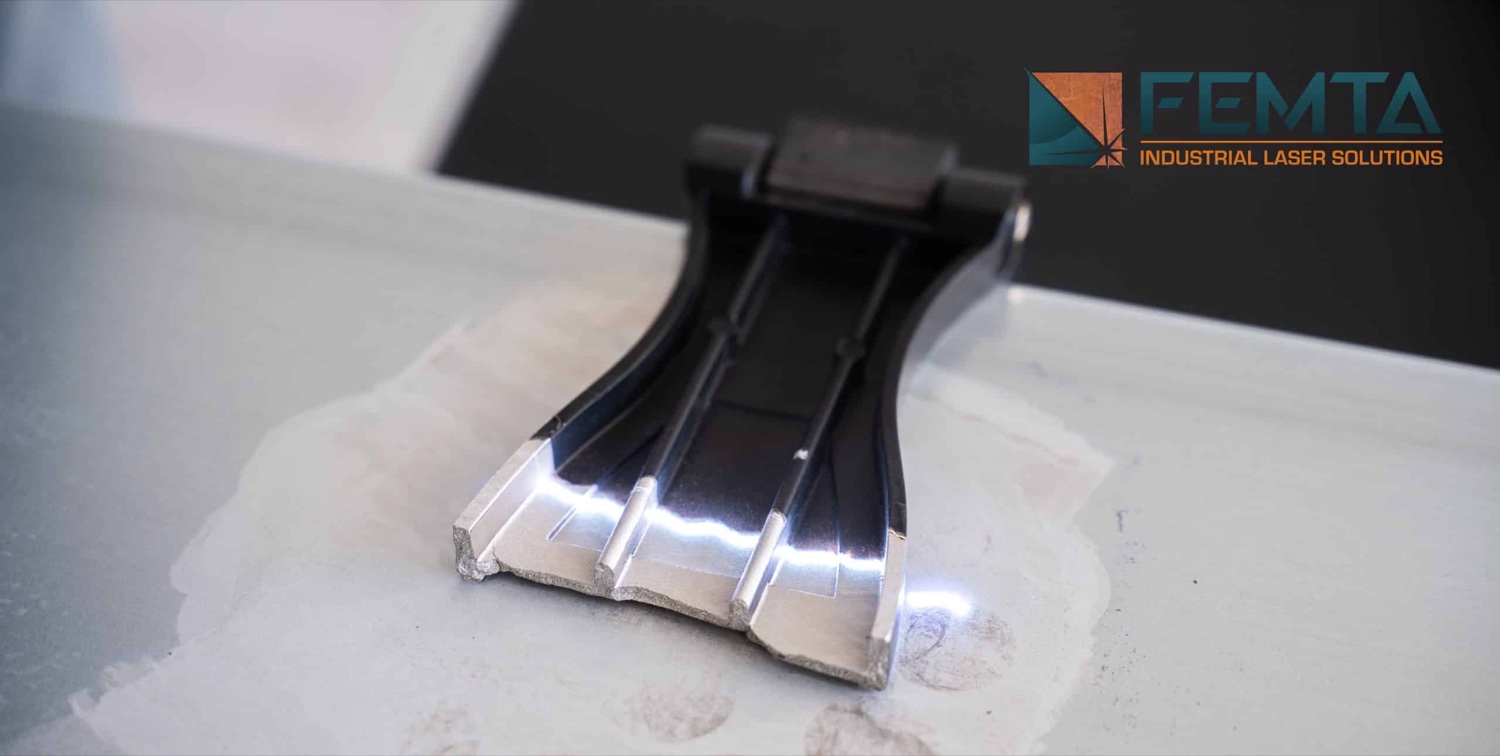
Laser cleaning removes contamination ablatively: pulsed laser light strikes the surface, and the layer of dirt, oxide or coating absorbs the energy and detaches from the base material, partly through thermal and partly through photochemical effects. Process parameters are set so that the energy couples primarily into the layer to be removed; the energy input into the part itself remains low (cold ablation). The process is non-contact and dry, working without chemicals or blasting media and with minimal water consumption. Detached particles and fumes are extracted.
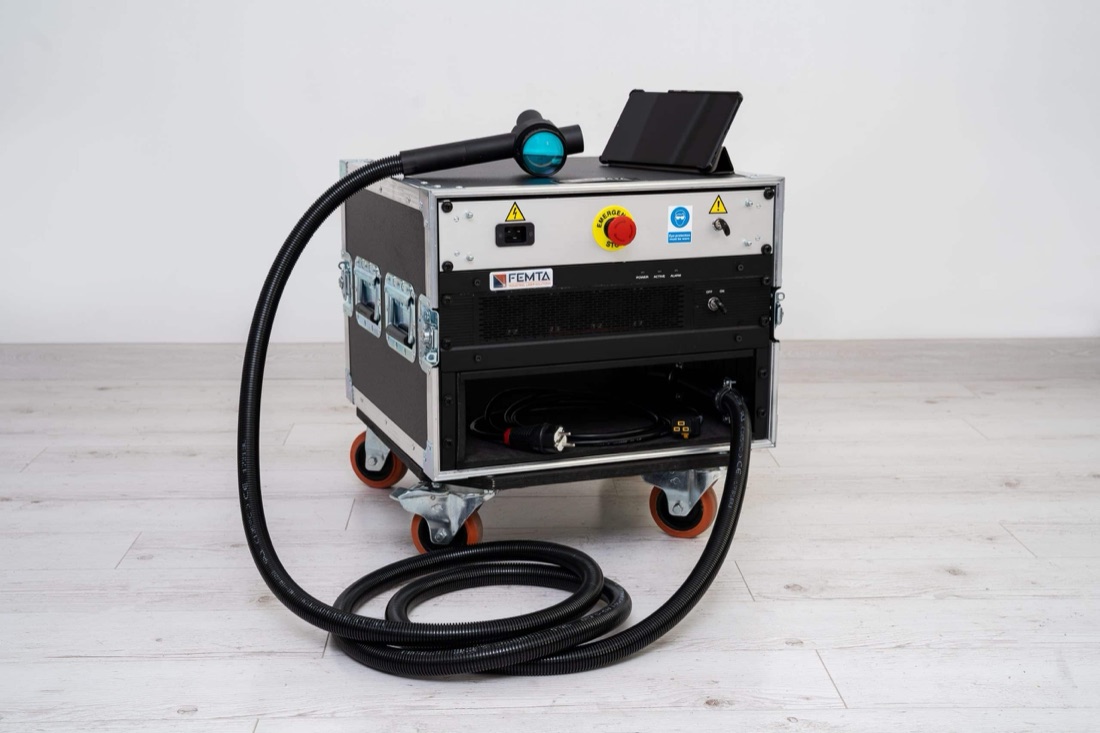
TeSe works with the laser systems of its technology partner FEMTA in Lithuania; depending on the task, both manual and automated set-ups (e.g. with cobots) are possible.
Laser cleaning uses high-power lasers of laser class 4 (per EN/IEC 60825-1); the corresponding laser-safety measures must therefore be observed during operation.
Two pulse classes, two jobs
FEMTA builds two families of systems that differ in pulse duration. That choice decides more about the result than power alone.
The nanosecond class works with pulses of 10 to 500 ns at repetition rates up to 8000 kHz. The short pulse releases its energy within a thin layer, so the base material takes up little heat. This is the choice for oxide layers, coatings and anything where the substrate has to be spared. These systems are air-cooled and run from an ordinary 230 V socket.
The microsecond class uses pulses of 2 to 200 µs at up to 5000 Hz. The longer pulse removes more material and suits thick rust and paint layers or large areas. These systems are liquid-cooled and require three-phase power.
Systems and power classes
| Model | Power | Scan field | Cooling | Supply |
|---|---|---|---|---|
| LCS-100C | 100 W | 150 × 150 mm | air | 230 V, < 4 A |
| LCS-100E | 100 W | 170 × 170 mm | air | 230 V, < 4 A |
| LCS-200C | 200 W | 150 × 150 mm | air | 230 V, < 5 A |
| LCS-200E | 200 W | 170 × 170 mm | air | 230 V, < 5 A |
| LCS-200X | 200 W | 170 × 170 mm | air | 230 V, < 5 A |
| LCS-300C | 300 W | 150 × 150 mm | air | 230 V, < 6 A |
| LCS-1500C1 | 1500 W | 1 × 400 mm (line) | liquid | 230 V, 6.5 kW |
| LCS-1500C2 | 1500 W | 300 × 300 mm | liquid | 230 V, 6.5 kW |
| LCS-2000C2 | 2000 W | 300 × 300 mm | liquid | 400 V, 9 kW |
| LCS-3000C | 3000 W | 300 × 300 mm | liquid | 400 V, 12 kW |
| LCS-6000C | 6000 W | 2 × 500 mm (line) | liquid | 400 V, 24 kW |
Three differences are worth a second look. The E versions scan a larger field (170 instead of 150 mm) and have a lighter handpiece, but need a larger housing. The LCS-200X is the only one with freely programmable scan patterns: where the other systems handle line, sine, circle and rectangle, any contour can be defined in software here. And the line scanners LCS-1500C1 and LCS-6000C produce a narrow, long line instead of a square, designed for continuous material and large areas in a pass.
All systems work in the near infrared (1064 to 1080 nm), are CE-certified as class 4 installations and documented with a PL-D safety validation report. The fibre length between system and handpiece is 5 m as standard and extends to 20 m. FEMTA states a service life of more than 90,000 operating hours and a 24-month warranty.
Our application lab in Nürensdorf is equipped with an LCS-200E from the nanosecond class. We test your part on it before any decision about a system is made. The full datasheets for every model are available in the media library.
Advantages
- Non-contact: no mechanical contact with the part; as the process uses no consumable media, it leaves no blasting-media or chemical residues.
- Selective and gentle on the substrate: parameters can be tuned to the layer being removed, preserving the base material.
- Cost-efficient: few consumables, less manual work, low operating costs.
- Sustainable: free of chemicals and abrasives, minimal water consumption, no blasting media or baths to dispose of.
- Suitable for automation: as a manual workstation or an integrated solution, e.g. with cobots and fume extraction.
- Suva-compliant: the FEMTA laser systems used meet all Swiss legal requirements.
Typical applications
- Aviation
- Medical technology and watchmaking
- Tool and mould cleaning (plastics, tyre and casting moulds)
- Metal and aluminium surfaces (e.g. removal of oxides, rust and coatings)
- Printing and electronics industries
- Automotive and food industries
- Graffiti removal and art restoration
Every recommendation is based on laboratory analyses of customer samples. As a technology-neutral provider, TeSe also checks whether another process is a better fit for your application.
Test the process at TeSe
Trial laser cleaning on your own parts: 1–2 hours of testing free of charge; in-depth feasibility studies. CHF 1’200 per day, 50% credited towards a machine purchase.
Documents & videos for this process
Datasheets & brochures
- FEMTA Laser Cleaning · BrochureEN
- FEMTA LCS-100C (100 W) · DatasheetEN
- FEMTA LCS-100E (100 W) · DatasheetEN
- FEMTA LCS-200C (200 W) · DatasheetEN
- FEMTA LCS-200E (200 W) · DatasheetEN
- FEMTA LCS-200X (200 W, frei programmierbare Scanmuster) · DatasheetEN
- FEMTA LCS-300C (300 W) · DatasheetEN
- FEMTA LCS-1500C1 (1500 W, Linienscanner) · DatasheetEN
- FEMTA LCS-1500C2 (1500 W) · DatasheetEN
- FEMTA LCS-2000C2 (2000 W) · DatasheetEN
- FEMTA LCS-3000C (3000 W) · DatasheetEN
- FEMTA LCS-6000C (6000 W, Linienscanner) · DatasheetEN
Videos
Technology Partner · FEMTA