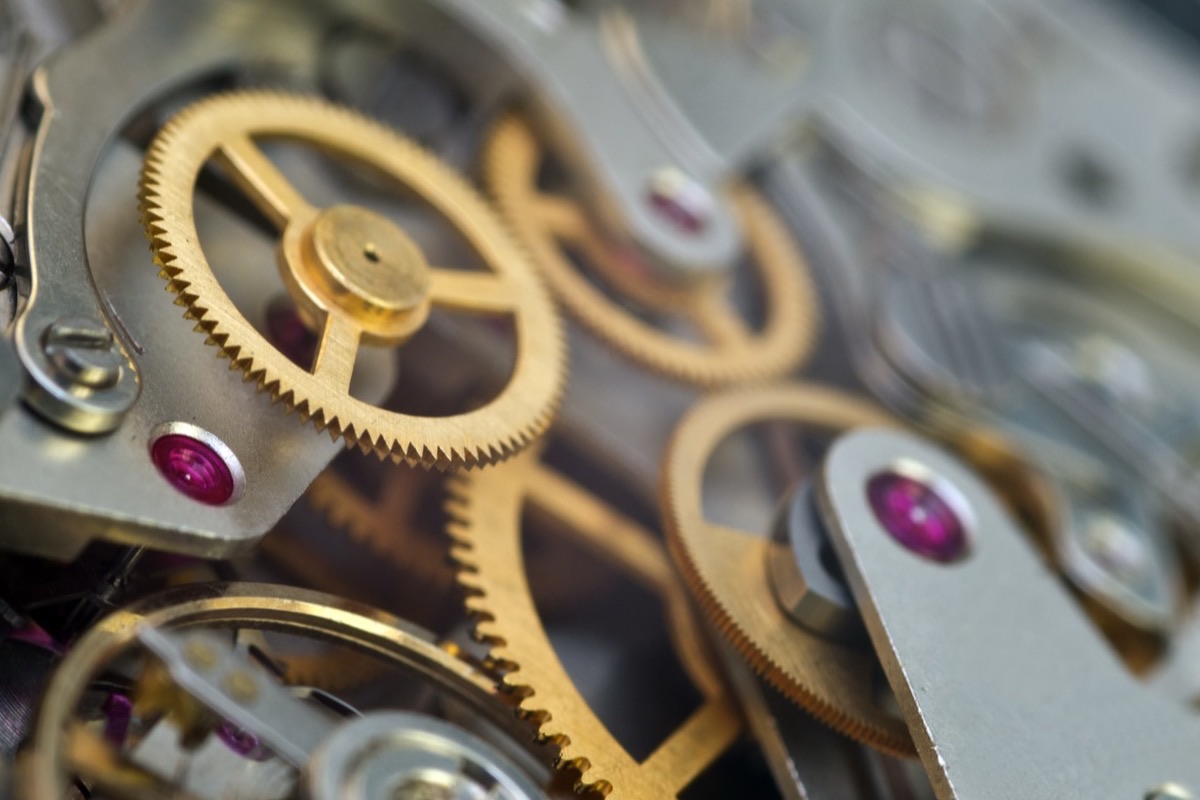
Requirements in watchmaking and luxury goods
Watchmaking and the luxury goods industry are the sector in which TeSe has its strongest presence. Here, what counts is very small parts, fine geometries and visible, often high-gloss surfaces. Cleaning has to be reliable and reproducible, and at the same time gentle, so that appearance and functional surfaces are not affected.
The range extends from large manufactures with high volumes to smaller labels producing small series but with the highest demands. Because a very high added value is embedded in a small number of parts, often made by hand or semi-automatically, the reject rate must be kept to a minimum, and the demand for the highest cleanliness increasingly applies to the entire industry.
Typical components and contamination
From this industry, we clean above all:
- Components: ébauche and movement parts, cases, dials, escapement parts, balance wheels, screws and hands, practically all watch parts from machining, forming or injection-moulding production
- Materials: ceramics, precious metals of all kinds, lead-free brass alloys, stainless steels, non-magnetic steels, copper, brass, spring steels and case-hardening steels
- Contamination: oils and greases, polishing pastes and polishing residues, fingerprints as well as chips, flitter and micro-burrs, practically all impurities that arise during the production process
The combination of extremely fine geometries, sensitive visible surfaces and high-quality materials makes the task demanding: cleaning must be reliable, without attacking the appearance or the functional surfaces.
Suitable processes
In watchmaking and luxury goods, TeSe has a strong presence: from solvent and multi-bath immersion cleaning in line to hybrid systems with TwinTec technology (solvent and aqueous media in one machine), many such systems are in use at watch manufacturers. For micro-deburring on ébauche parts (bridges) and for removing polishing residues on watch cases, ACP’s CO₂ snow and PowerSnow blasting is also particularly attractive.
Which process fits best depends on the part, the contamination and the batch size: we advise on a technology-neutral basis. For this industry, the following are particularly relevant:
- Wet-chemical cleaning: solvent and aqueous cleaning, multi-bath immersion systems in line and hybrid systems (RCTS with TwinTec technology)
- CO₂ snow blasting: CO₂ snow and PowerSnow blasting (ACP) for gentle cleaning and micro-deburring of ébauche parts (bridges)
- Ultrasonic cleaning: thorough cleaning of fine geometries and cavities in an immersion bath
- Laser cleaning: selective, contactless removal of defined contamination
Special baskets for delicate parts
So that delicate, high-value parts reach the required cleanliness without being damaged during cleaning, special baskets (workpiece carriers) are used: particularly for sensitive loads such as mirror-polished or diamond-machined surfaces. The baskets, usually made of stainless steel, are often given an additional coating for this purpose, which protects the sensitive surfaces.
Downstream processes
In watch and luxury goods manufacturing, cleaning is followed by practically every conceivable process step, from thermal further processing through coating and decoration to assembly. Frequently, parts are deliberately re-oiled after cleaning to prepare them for further forming processes. Because every downstream step places its own demands on the surface, we always define the cleanliness target from the next process step, not the other way around.
Measurement and quality assurance
The watch industry works less with cross-industry standards such as VDA 19 than with customer-specific cleanliness standards, which can vary widely from one manufacturer to another.
TeSe carries out some of the inspections in-house, including checks under a high-resolution microscope with various light sources as well as contact angle measurement to determine the surface tension. More advanced tests such as scanning electron microscopy (SEM) or chemical analyses are mostly customer-defined processes that TeSe partly supports, always aligned with the respective customer specification.
Process and chemical loop from a single source
In this industry in particular, a closed loop pays off: TeSe supplies the cleaning systems and, together with ZET-Chemie, the matching degreasers and the miscible oils to go with them, plus support with cleanliness analyses. In this way, customers map out an optimally coordinated process and chemical loop in which cleaning, preservation and further processing fit together seamlessly.
Practical example
At several larger watch labels, numerous TeSe systems are in use across different processes. A typical sequence: watch cases and bracelets are cleaned in a TeSe system before thermal further processing and then – likewise in a TeSe system – deliberately re-oiled to prepare them for further forming processes. Cleaning, preservation and chemistry thus interlock seamlessly.
Frequently asked questions
Which watch parts does TeSe clean? Ébauche and movement parts, cases, dials, escapement parts, balance wheels, screws and hands: practically all parts from machining, forming or injection-moulding production.
How is cleanliness tested in the watch industry? Mostly according to customer-specific standards. Microscopy, scanning electron microscopy (SEM) and chemical analyses are widespread; cross-industry standards such as VDA 19 play a smaller role here.
Does TeSe also clean very small series with the highest demands? Yes. It is precisely with small series with a high added value per part that a minimal reject rate counts: that is what our gentle processes are designed for.
Does TeSe also supply the chemistry? Yes. Together with ZET-Chemie, we supply coordinated degreasers and miscible oils plus analytical support, for a closed process and chemical loop.
Test the process at TeSe
Whether a process meets your industry’s requirements on your actual part is shown by a trial: 1–2 hours of testing free of charge. In-depth feasibility studies: CHF 1’200 per day, 50% creditable against a machine purchase.
Documents & videos
Datasheets & brochures
Solvent cleaning – Karl Roll
Vibration & inline cleaning – Ossberger
CO₂ snow & PowerSnow – ACP
- PowerSnow · BrochureEN
- JetWorker · DatasheetDEEN
- JetWorker High Purity · DatasheetEN
- JetStation · DatasheetDEEN
- JetStation High Purity · DatasheetEN
- JetModule · DatasheetDEEN
- JetModule High Purity · DatasheetEN
- JetCell · DatasheetDEEN
- JetCell High Purity · DatasheetEN
- High Purity Cleaning · BrochureEN
- ACP Systems AG · CertificateDE
- quattroClean CO₂ (Linde) · CertificateEN
Cleaning baskets
Videos
CO₂ snow blasting
Process chemistry
Vibration cleaning