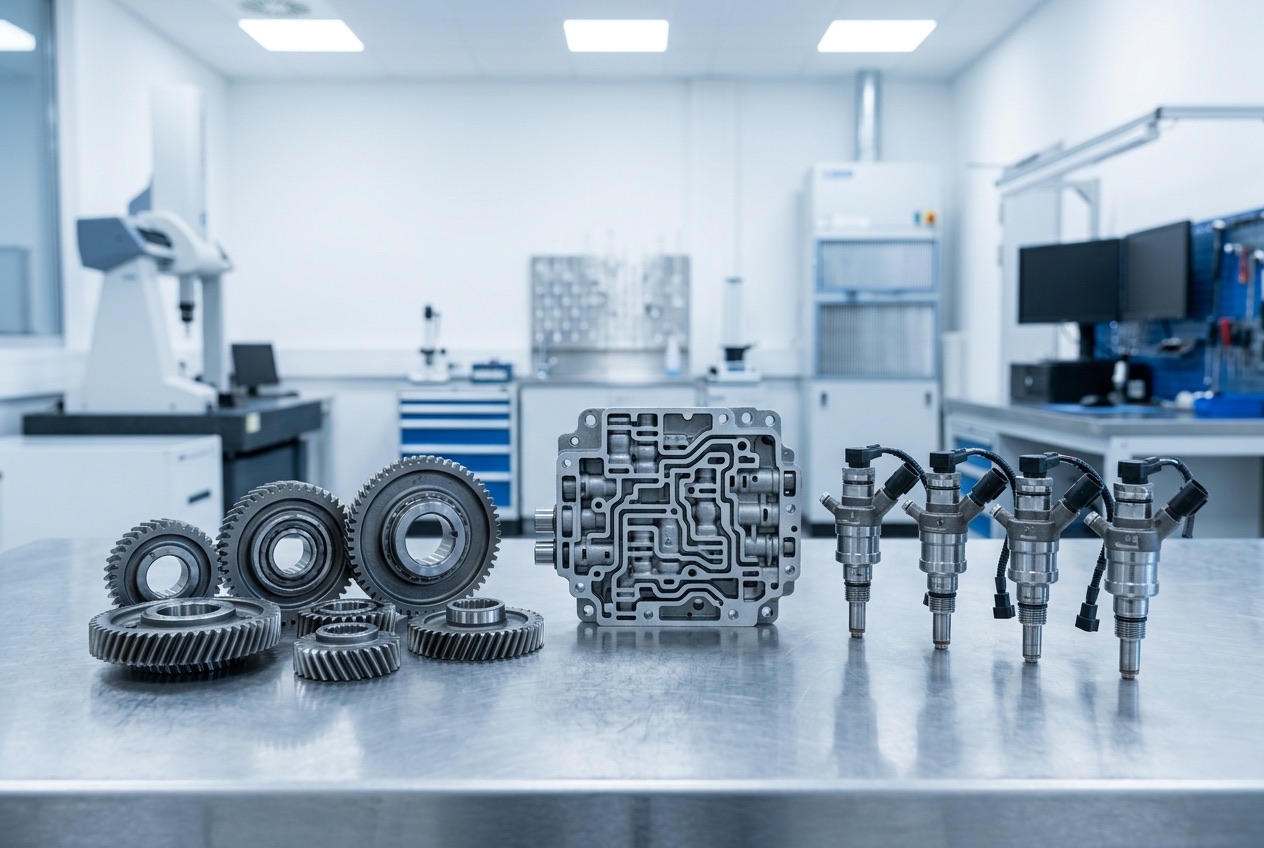
Requirements in automotive
In the automotive sector, component cleanliness is an integral part of quality requirements along the supply chain. Oils, greases, chips and filmic residues have to be removed process-reliably, often inline and in series, from high-volume production in cycle to batched lots.
In the automotive industry, the benchmark for component cleanliness is VDA 19 (closely linked to ISO 16232): the rule set of the German Automotive Industry Association (VDA) covers both particulate and filmic (smear) contamination and defines the corresponding measurement and analysis methods. This defined, verifiable cleanliness is exactly what our cleaning processes target.
Typical components and contamination
From this industry we primarily clean:
- Components: sensors, forming and stamping parts, turned parts of all kinds (such as electrical contacts) as well as micro-turned parts
- Materials: aluminium, steel, cast iron, stainless steel, non-ferrous metals and plastics, including coated sheet metal
- Contamination: oils and emulsions, chips, polishing pastes as well as drawing greases
Because these residues directly affect downstream processes and component function, the cleanliness target is defined from the next process step.
Suitable processes
Which process fits best depends on the part, the contamination and the batch size: we advise on a technology-neutral basis. For this industry, the following are particularly relevant:
- Wet-chemical cleaning: aqueous or solvent-based cleaning, also for oils and greases
- High-pressure cleaning & deburring: cleaning and deburring with the high-pressure water jet
- Laser cleaning: selective, contactless removal of defined contamination
- Plasma & corona pre-treatment: cleaning and surface activation before bonding or coating
- CO₂ snow blasting: dry, residue-free cleaning in step with the cycle
Downstream processes
In the automotive sector, cleaning is typically followed by bonding, coating (including e-coat), joining and welding, assembly as well as the sealing of sealing surfaces. Each of these steps requires a defined clean surface: which is why the cleanliness target always follows the next process step.
Measurement and quality assurance
The benchmark is VDA 19. The complete, standard-compliant residual contamination analysis to VDA 19 is not run automatically in-house, but predominantly on the customer side: sometimes with a dedicated extraction cabinet.
In-house, TeSe uses a high-resolution microscope and special light sources to make both particles and organic contamination visible; contact angle measurement (surface tension) is also available. This makes the cleaning result traceably assessable and aligns it with the customer-side VDA 19 inspection.
Chemistry and cost-effectiveness
The automotive industry is highly price-sensitive: the service life of the cleaning media counts. For this, ZET-Chemie offers both solvents (such as ZET clean 56S, 82 and 82i) and aqueous cleaners, complemented by stabilisers that keep the solvent in the circuit for a long time. This keeps cleaning quality and operating costs in balance across the production run.
Practical example
A typical case: stamped-bent parts onto or into which electronics are subsequently mounted. Here, particulate and filmic (smear) contamination is fatal, it can lead to short circuits or oxidation. Accordingly, the cleanliness has to be defined and verifiable.
Frequently asked questions
Which automotive parts does TeSe clean? Sensors, forming and stamping parts, turned parts of all kinds (such as electrical contacts) as well as micro-turned parts.
Against which benchmark is cleanliness assessed? Against VDA 19 (closely linked to ISO 16232). The standard-compliant residual contamination analysis is predominantly on the customer side; in-house, TeSe makes particles and organic contamination visible under the microscope and measures the contact angle.
Is the cleaning suitable for high-volume series? Yes: inline in cycle as well as batched.
How does the cleaning stay cost-effective? Through durable cleaning media from ZET-Chemie (solvent and aqueous), prepared with stabilisers, that remain in the circuit for a long time.
Test the process at TeSe
Whether a process meets your industry’s requirements on your actual part is shown by a trial: 1–2 hours of testing free of charge. In-depth feasibility studies: CHF 1’200 per day, 50% creditable against a machine purchase.
Documents & videos
Datasheets & brochures
Wet-chemical cleaning (aqueous) – Karl Roll
Solvent cleaning – Karl Roll
CO₂ snow & PowerSnow – ACP
- PowerSnow · BrochureEN
- JetWorker · DatasheetDEEN
- JetWorker High Purity · DatasheetEN
- JetStation · DatasheetDEEN
- JetStation High Purity · DatasheetEN
- JetModule · DatasheetDEEN
- JetModule High Purity · DatasheetEN
- JetCell · DatasheetDEEN
- JetCell High Purity · DatasheetEN
- High Purity Cleaning · BrochureEN
- ACP Systems AG · CertificateDE
- quattroClean CO₂ (Linde) · CertificateEN
Videos
CO₂ snow blasting
Wet cleaning
Process chemistry