How it works
Electrostatic charges build up wherever materials are separated, rubbed or moved: particularly on electrically non-conductive materials such as plastics, films or glass. Charged surfaces attract dust and particles from the ambient air, interfere with downstream process steps such as painting, printing or bonding, and can affect sensitive components through uncontrolled discharges.
Ionisation counteracts this effect in a targeted way: ionising devices generate positive and negative ions at electrode tips using high voltage. When these ions reach a charged surface, the charge is neutralised. Combined with compressed air – for example in ion guns – adhering particles are blown off in the same operation, without the residual charge immediately attracting them again.
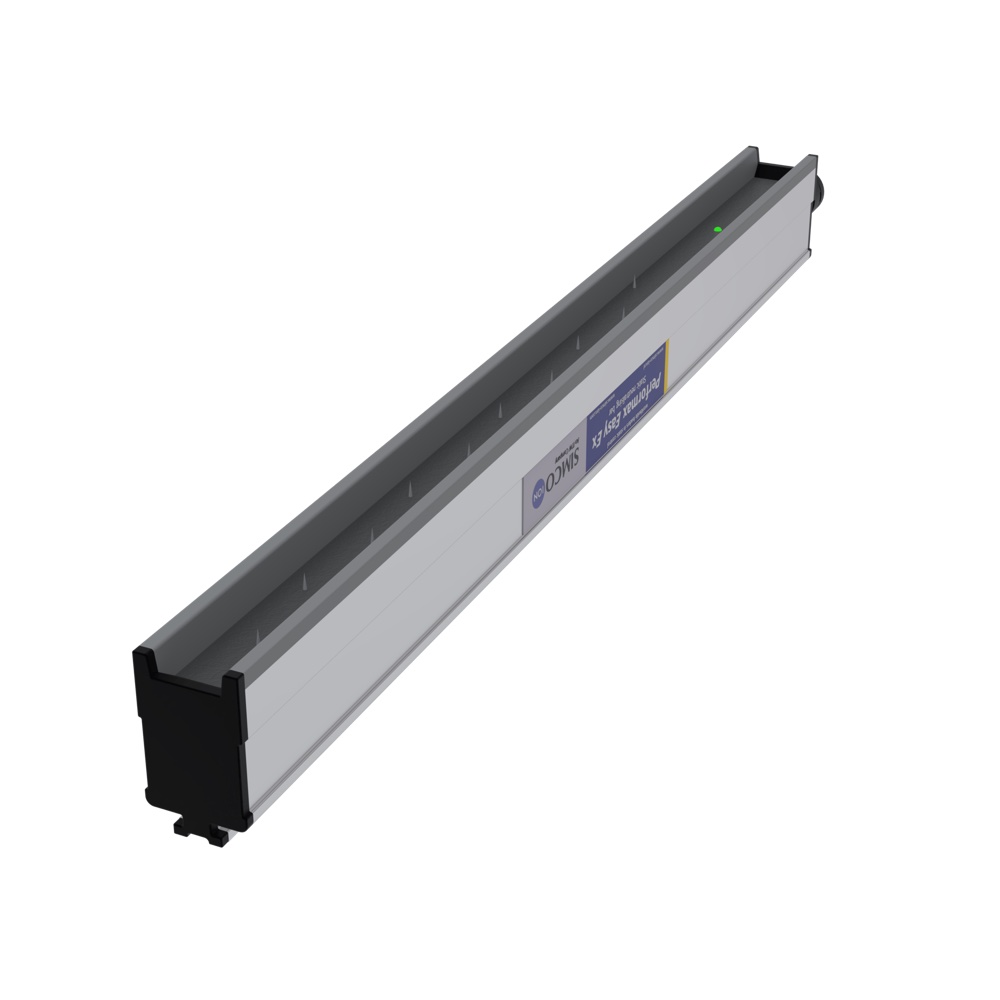
TeSe relies on ionisation technology from its technology partner Simco-Ion and offers both hand-held and stationary solutions. For manual discharging and cleaning, the ion guns Cleanflex Easy, TopGun and Cobra are available in the TeSe shop.
Typical problems from the field
Customers come to us for a wide variety of reasons: usually one of these patterns lies behind it:
- Dust on freshly cleaned parts: the surface charges up again during handling and attracts particles, the cleaning seems “ineffective”.
- Films and parts stick together or cannot be cleanly separated and positioned.
- Shocks and sparks at the workstation, unpleasant for staff and risky for ESD-sensitive assemblies.
- Rejects in printing, painting or bonding because charge attracts particles or disrupts the material flow.
In all these cases, the first step that pays off is a measurement: because you can only effectively combat what you know.
Measuring charge
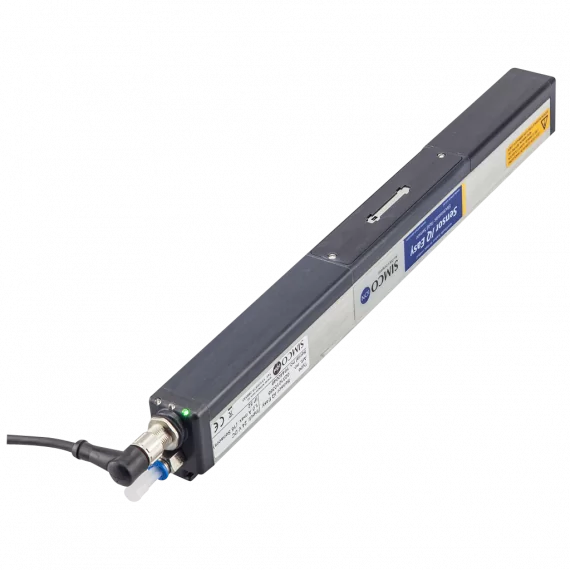
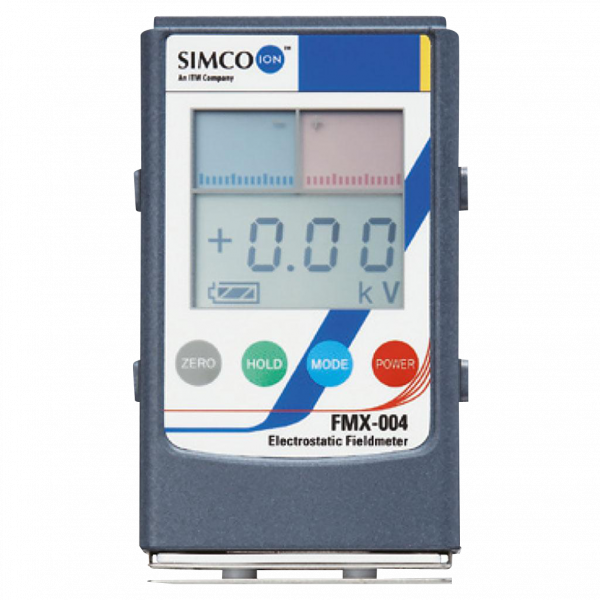
Whether and how strongly a surface is charged is revealed by the Simco-Ion FMX-004 electrostatic fieldmeter: it measures static charge with a readout in volts or kilovolts and additionally detects the polarity of the charge, the basis for specifying the right discharging or charging solution. The FMX-004 is also available for purchase from TeSe, so that you can permanently monitor charge levels in your own process.
On request, we carry out measurements directly at your site, in the running process, right where the problem arises.
Intelligent charge control: the IQ Easy platform
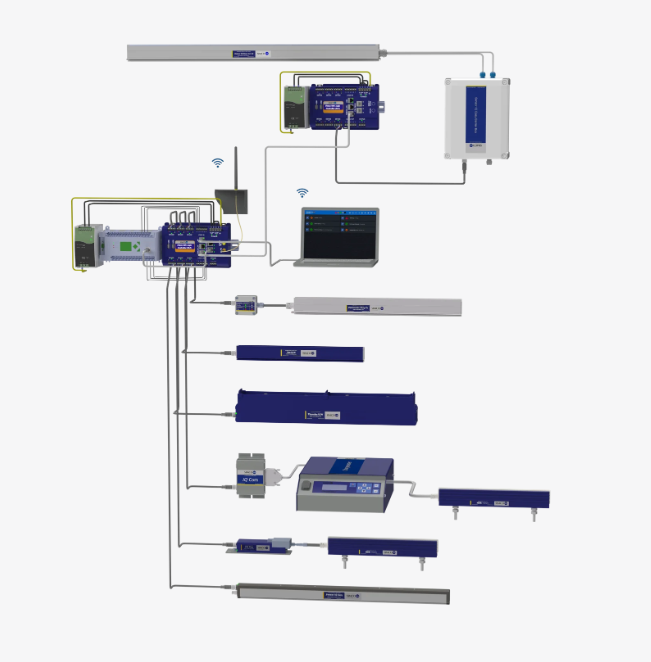
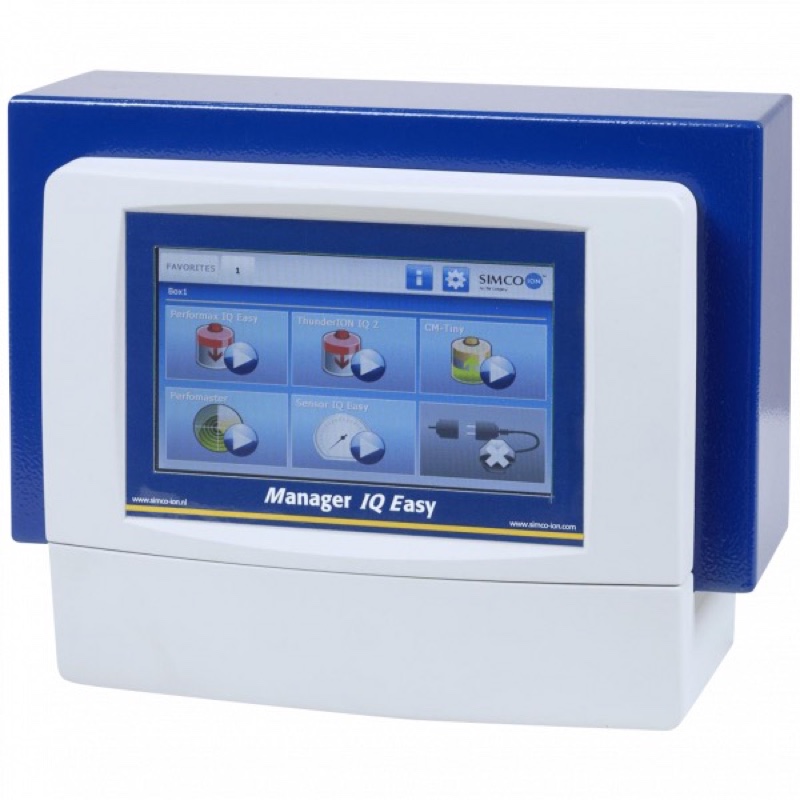
Today, electrostatics can not only be neutralised but also intelligently regulated: the IQ Easy platform from Simco-Ion adapts charging and discharging automatically to the values measured in the process, sensors detect the residual charge and the devices adjust in real time. As the central controller, the Smart SLC (Simco-Ion Logic Controller) connects up to 84 IQ Easy devices; access is via common control protocols over fieldbus (e.g. EtherNet/IP, ProfiNet) directly from the machine control, or browser-based via laptop, tablet and smartphone. The proven Manager IQ Easy system remains available. Central monitoring and real-time optimisation improve production quality and reduce downtime.
Targeted charging and measurement
The same technology also masters the opposite direction. In in-mould labelling (IML): a strength of Simco-Ion: targeted static charging holds the decorative label precisely against the inner mould surface during injection moulding. Exact placement, efficient process. And electrostatics also works as a measurement technique: if the charge from a charging bar arcs through at a flaw, it can be used to detect film defects and measure perforations, reliable inline quality control in film processing.
Product range, demo units and delivery times
Demo units are available for trials, for testing, borrowing or renting, in your process or at TeSe. Ionising bars are manufactured to fit your installation situation; the delivery time is typically 1–3 weeks.
For Ex/ATEX zones, ATEX variants are available. They are not held in stock and are organised on a project basis; the proven approach is to test with the standard device first and then order the ATEX version. From measurement and positioning of the bars to integration into the machine control, everything comes from a single source.
Limits and planning
Ionisation works reliably: when the design is right. From practice, we know three typical stumbling blocks:
Where a physical issue adds to the electrostatics (e.g. airflow, mechanics, humidity), an ionising bar alone falls short. The overall process then needs to be analysed.
In existing lines there is often no room to install the bar where it would need to act: working distance and installation position decide success. And if discharging is required at several points, the question of control and cost becomes central; this is where the networked IQ Easy platform pays off.
We clarify exactly these points in a consultation or directly on site: before any investment is made.
Why TeSe for electrostatics
We think of electrostatics together with plasma & corona pre-treatment and parts cleaning, often it is only the combination that solves the problem. Behind this stands deep process and technology know-how, with personal consulting instead of catalogue selling.
For demanding cases, the manufacturer’s extensive test laboratory is available. In Switzerland, we are also supported by a Simco process engineer with two decades of experience in electrostatic applications across all industries.
Practical examples
- A Swiss manufacturer of large-format printing machines (flatbed and roll-fed printers for advertising posters) uses ionisation technology so that charge neither attracts dust nor disturbs the printed image.
- A manufacturer of IML handling systems uses targeted charging to insert and position labels precisely in the injection mould.
- In electronics manufacturing, Simco-Ion technology supplies machines and manual workstations with neutral ionised air.
- At a manufacturer of large-scale plants for the packaging industry, Simco-Ion bars safeguard process reliability; in plastics processing, electrostatics fixes labels during IML.
Advantages
- Reduces dust attraction on charged surfaces, and with it rework and rejects
- Dry process without chemicals, no drying steps required
- Discharging and blowing off adhering particles in a single operation
- Hand-held devices for the workstation, stationary systems for integration into production lines
- Reduces the risk of uncontrolled electrostatic discharges on sensitive assemblies
- IQ Easy platform: automatic adaptation of charging and discharging to measured process values
- Connection to machine controls via common fieldbus protocols (e.g. EtherNet/IP, ProfiNet)
- Measured instead of guessed: capture field strength and polarity with the FMX-004 – before and after the corrective measure
Typical applications
- Plastics processing: discharging and cleaning injection-moulded parts before assembly or packaging
- Painting, printing and coating: low-particle surfaces prior to application
- Film and print processing with charge-related handling problems
- Assembly and packaging processes where adhering dust impairs quality
- Workstations with ESD-sensitive components
- In-mould labelling (IML): targeted charging fixes labels in the injection mould
- Inline quality control: detecting film defects and measuring perforations via charge breakthrough
Frequently asked questions
How do you measure electrostatic charge? With an electrostatic fieldmeter such as the Simco-Ion FMX-004: it displays the charge in volts or kilovolts and detects the polarity. On request, TeSe measures directly in your process; the device is also available for purchase.
How do you discharge plastic parts or films? With ionisation: Simco-Ion devices generate positive and negative ions that neutralise the charge on the surface, as an ionising bar in the line, as an ion gun with compressed air at the workstation, or as a networked IQ Easy solution.
Why does plastic attract dust again immediately after cleaning? Because the surface charges up again during handling and attracts particles from the air. The remedy is discharging at the right moment: ideally combined with ionised blow-off in the final process step.
Can I test devices before buying? Yes. TeSe keeps a demo range for testing, borrowing or renting, and 1–2 hours of trials at our site are free of charge.
How quickly are ionising bars available? Bars are manufactured to fit your installation situation; the delivery time is typically 1–3 weeks.
Are ATEX versions available for Ex/ATEX zones? Yes, they can be ordered on a project basis. The usual approach is to test with the standard device and then procure the ATEX variant.
Test the process at TeSe
We will verify together, on your own parts, whether ionisation solves your dust or charging problem: 1–2 hours of testing free of charge. In-depth feasibility studies: CHF 1’200 per day, 50% credited towards a machine purchase.
Documents & videos for this process
Electrostatics / ionisation – Simco-Ion
Static discharge (ionization) 16 datasheets
Ionizing bars
Static charging 8 datasheets
Measurement & control 4 datasheets
Videos
Technology Partner · Simco-Ion